
AI is changing the way businesses operate, from automating repetitive tasks to supporting more complex decision-making. Two of the most talked-about technologies are AI agents and AI automation. While they share some similarities, they solve different problems and offer different benefits. Understanding where each fits can help businesses make smarter decisions about adopting AI.
Whether you’re looking to streamline internal processes or explore new ways to increase efficiency, understanding the difference between AI agents and AI automation is an important first step.
In this guide, we’ll explain how each works, where they can add value and how businesses can use them together to drive meaningful results.
Think of it like this: AI automation is a world-class pianist who executes a complex piece of sheet music perfectly every single time. An AI agent is the conductor who watches the whole orchestra, listens to the crowd and tweaks the tempo on the fly to make sure the entire performance is a hit.
What is an AI Agent?
An AI agent is a system designed to achieve a goal by making decisions and taking actions on behalf of a user or business. Unlike traditional software that follows fixed instructions, AI agents can interpret information, evaluate options and choose the best next step based on context.
While automation handles the repetitive, predefined processes, AI agents step in to interpret nuance and decide exactly how to reach the ultimate end goal.
If your business is exploring how AI agents could support decision-making or customer interactions, our team at AdVelocity can help you identify where they fit within your existing processes.
Examples of AI Agents
AI agents are most effective in situations where judgement, context and adaptability are required.
Customer Service: AI agents can handle customer queries, access account information, resolve issues and escalate more complex problems when needed.
Sales Development: They can research prospects, qualify leads, draft outreach messages and help schedule meetings.
Marketing: AI agents can analyse campaign performance and suggest improvements based on data.
Research: They can gather information from multiple sources and summarise insights into actionable outputs.
AI Search: As search behaviour evolves with tools like ChatGPT and Google AI Overviews, AI agents are becoming increasingly important in how information is discovered and presented.
This is why services such as AI Search Optimisation are becoming more relevant for businesses looking to stay visible in AI-driven search environments.
What Is AI Automation?
AI automation focuses on streamlining repetitive, structured tasks by following predefined workflows.
Rather than making complex decisions, AI automation improves efficiency by executing consistent processes at speed and scale.
If you’re new to this topic, you can explore a more detailed breakdown ‘What is Automation in AI for Business’.
Unlike AI agents, AI automation follows a clear set of rules. It is best suited to tasks that are predictable and repeatable.
Examples of AI Automation
AI automation is best suited to structured, repeatable business processes.
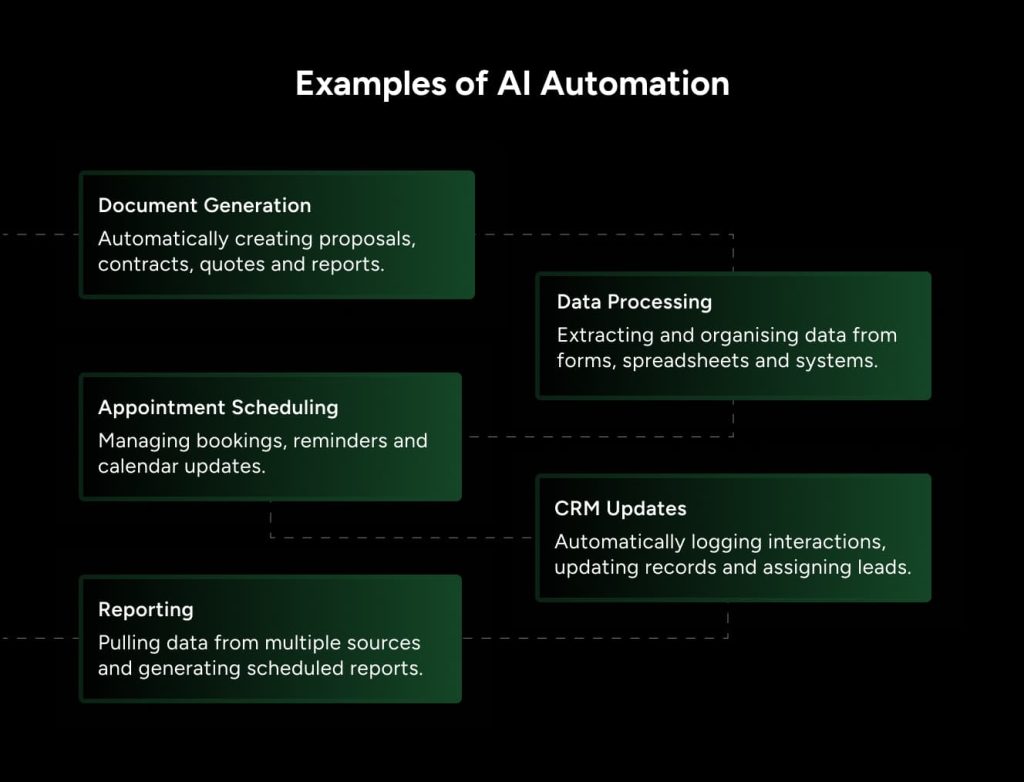
Document Generation: Producing proposals, contracts, quotes and reports on demand
Data Processing: Pulling information from forms, spreadsheets and systems, then structuring it ready to use.
Appointment Scheduling: Handling bookings, sending reminders and keeping calendars up to date.
CRM Updates: Logging interactions, refreshing records and routing leads.
Reporting: Combining data from across your tools into scheduled, ready-to-share reports.
These processes may seem small individually, but collectively they often take up a significant amount of internal time.
AI Automation has no limits. We supplied a bespoke AI Automation solution for a leading security company, helping speed up internal processes and efficiency.
AI Agents vs AI Automation: What’s the Difference?`
The key difference between AI Agents and AI Automation is simple: AI automation follows a process. AI agents pursue a goal.
| AI Automation | AI Agents |
| Follows predefined workflows | Works towards objectives |
| Limited decision-making | Dynamic decision-making |
| Best for repetitive tasks | Best for complex tasks |
| Highly structured | Highly adaptable |
| Efficiency-focused | Outcome-focused |
Both play an important role in modern business operations, but they are designed for different types of problems.
Unsure whether your business needs AI agents, automation or a combination of both? We can review your current workflows and recommend the most effective approach based on your goals.
How AI Agents and AI Automation Work Together
The most effective AI systems often combine both technologies.
For example:
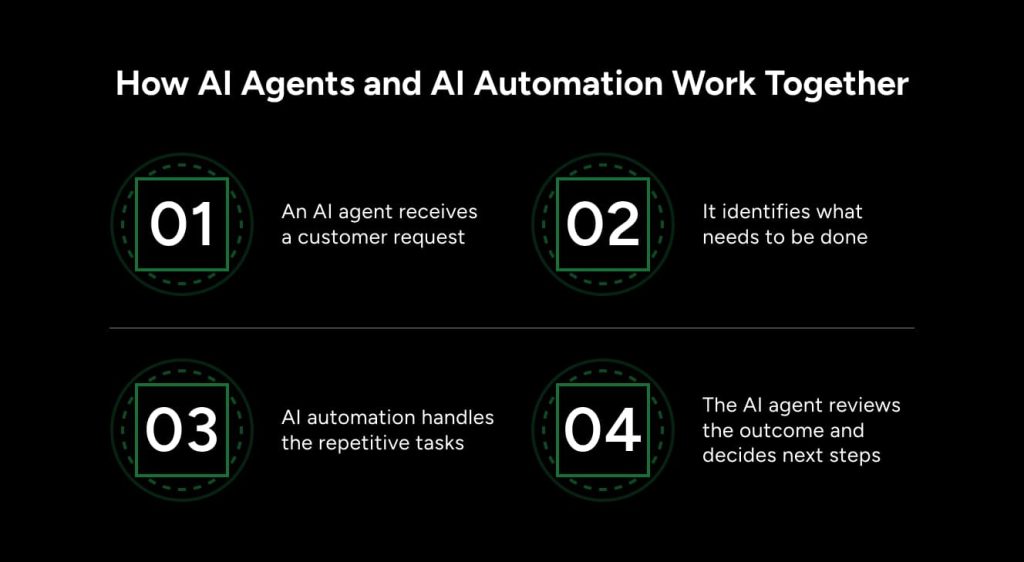
- An AI agent receives a customer request
- It identifies what needs to be done
- AI automation handles the repetitive tasks
- The AI agent reviews the outcome and decides next steps
This creates a balance between intelligence and execution. AI agents provide decision-making. AI automation delivers consistency and scale. Together, they enable businesses to reduce manual work while maintaining control and accuracy.
How AdVelocity Helps Businesses Implement AI
At AdVelocity, we help businesses move beyond theory and implement AI in a practical, results-driven way.
Rather than adopting AI for the sake of it, we focus on identifying where it can deliver real operational value.
We typically start by analysing existing workflows to identify:
- Repetitive tasks that can be automated
- Decision-heavy processes that could benefit from AI support
- Bottlenecks where teams are losing time
- Opportunities to connect disconnected systems
From there, we design and implement tailored solutions through our AI Automation Services.
This may include:
- Workflow automation across CRM and internal systems
- AI-powered reporting and data processing
- Lead routing and customer response systems
- Internal process optimisation
For more advanced use cases, we also explore how AI agents can support complex, multi-step workflows and decision-making tasks.
Choosing the Right AI Approach for Your Business
AI agents and AI automation are not competing technologies. They are complementary.
AI automation handles structure and repetition.
AI agents handle complexity and decision-making.
Businesses that understand how to use both effectively will be better positioned to improve efficiency, reduce costs and scale operations in a sustainable way.
The key is not choosing one over the other, but understanding where each adds the most value.
The most effective AI consultancy strategies are not about replacing systems, but improving how your business already operates. If you want to explore where AI could have the biggest impact, speak to our team.